
|
EN
Subscribe to our Newsletter
In an industry built on speed, excess, and constant visual performance, her presence operates differently. Where fashion imagery demands immediacy and emotional availability, Yai withholds. She slows the image, compresses its energy, and shifts power away from spectacle toward control. What emerges is not visibility as exposure, but authority as structure, quiet, deliberate, and impossible to ignore.
By the Editorial Staff

Photo by: Listal
Anok Yai: Minimalism as Visual Authority
Against the Language of Excess
Anok Yai’s presence operates in direct opposition to the dominant visual language of contemporary modeling. In an industry where visibility is typically produced through excess, gesture, emotion, narrative, and constant motion, Yai constructs authority through subtraction. Her images do not compete for attention; they reorganize the conditions under which attention becomes unavoidable.
Fashion imagery today is structured around immediacy. Bodies are expected to communicate instantly, to perform legibility, to offer emotion on demand. Yai interrupts this system not by amplifying herself, but by slowing the image down. She withholds where others explain. This refusal is neither passive nor accidental; it is deliberate, disciplined, and strategic.
To read Anok Yai simply as a successful model is to misunderstand the nature of her impact. Her work functions less as representation and more as a visual system, one that shifts power away from spectacle and toward control. What she offers is not presence as display, but presence as dominance.
Minimalism, in Yai’s work, is not aesthetic restraint for its own sake. It is a method of governance. In contemporary fashion, minimalism is often treated as neutrality, a quiet backdrop against which clothing can speak. For Yai, minimalism operates differently: it limits access. Every removed gesture, every neutralized expression, every moment of arrested movement intensifies the viewer’s focus. There is nothing to distract from the body as a site of authority.
This approach directly contradicts the economy of display that defines the modeling industry. Images are designed to be emotionally accessible, immediately readable, and rapidly consumed. Drama and expressiveness function as accelerators of visibility. Yai refuses this acceleration. Her images delay comprehension. They resist instant emotional payoff. In withholding expressive transparency, she denies the viewer the satisfaction of quick interpretation.
This visual silence is not emptiness; it is tension. Where most fashion imagery invites interpretation, Yai’s images impose confrontation. The viewer must linger, negotiate their gaze, and sit with ambiguity. In this exchange, power shifts. Consumption slows. Access becomes conditional. Visual silence becomes an act of refusal, of overexposure, of emotional labor, of performative availability.
Her stillness collapses in the distance. With no expressive cues to follow and no narrative gestures to decode, the viewer is left with structure, posture, alignment, spatial occupation. Power does not emerge through expansion or energy, but through containment. The image becomes dense, resistant to casual consumption. Minimalism ceases to be a stylistic choice and becomes a governing principle.
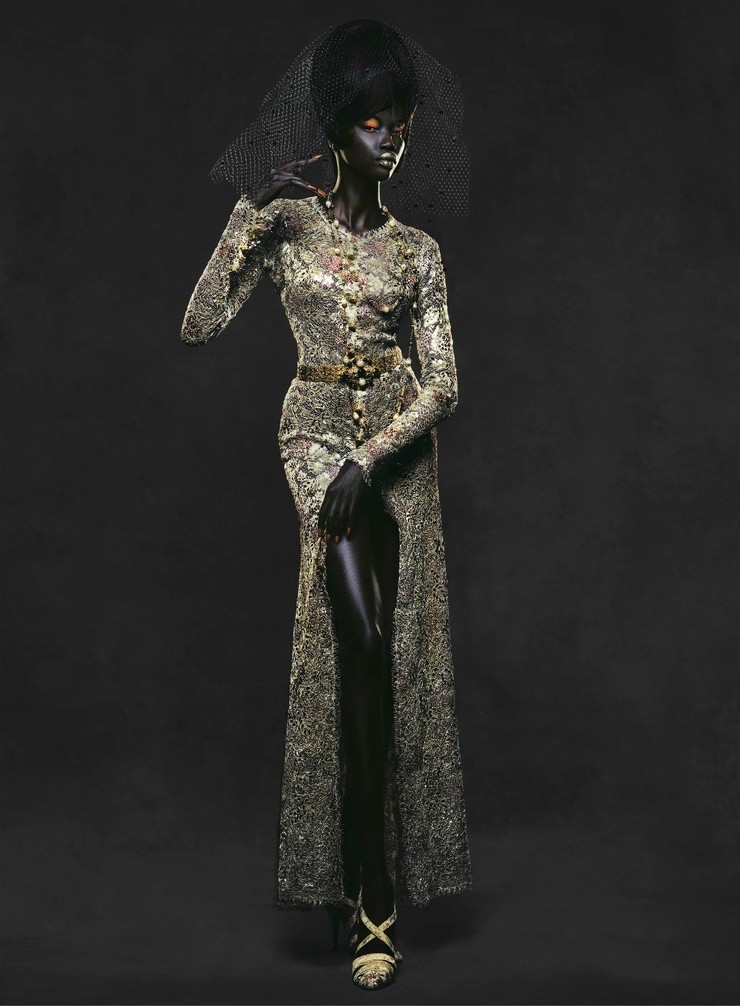
Photo by: Listal
Her authority is articulated most precisely through micro-decisions of the body. The gaze is often direct but never aggressive. It neither seduces nor challenges overtly; it stabilizes the frame. The viewer does not feel invited or rejected, but positioned. Gestures appear suspended rather than completed, arms held mid-motion, torsos aligned but withheld. The body never “arrives” at expression. It remains in control of its potential.
The face, crucially, resists narration. It does not perform interiority or signal emotion. This preservation of opacity is central to authority. What emerges is power without performance, presence without demand, control without aggression.
Fashion discourse often locates minimalism in clothing, clean lines, reduced ornamentation, neutral palettes. Yai reverses this hierarchy. In her work, the body is minimalized, not the garment. The body becomes structured; the garment adapts. Clothing no longer has meaning, it responds to it. Rather than serving as a neutral hanger for design, Yai’s body dictates the visual logic of the image. This inversion quietly challenges one of fashion’s oldest assumptions: that garments command attention and bodies comply.
Visibility is often mistaken for impact.
Yai demonstrates the opposite. She does not seek attention; she eliminates alternatives. Her presence restructures the image so that ignoring her becomes impossible, not because she demands recognition, but because the image offers no competing focal points. Attention is not attracted; it is cornered. Presence endures where attention fades.
Her visual language also resists speed. In a digital culture defined by scrolling and rapid consumption, Yai’s images interrupt rhythm. They reward duration. They insist on time. This slowness is not nostalgic; it is political. By refusing immediacy, she challenges the assumption that relevance must be instant. Control over tempo becomes control over visibility itself.
While her work should not be reduced solely to questions of race, it cannot be separated from them. Historically, Black bodies in fashion imagery have been overdetermined, framed through excess emotion, spectacle, or intensity. Yai’s restraint disrupts this legacy. Her minimalism refuses caricature. It denies the expectation of expressive surplus and asserts authority through control rather than confrontation.

Photo by: Listal
Finally, Yai’s power lies not in constant reinvention, but in coherence. Across campaigns, editorials, and runways, her visual language remains disciplined. This consistency builds authority, not familiarity. In an industry obsessed with novelty, coherence becomes radical.
Anok Yai does not ask for attention. She reorganizes the image so that attention has nowhere else to go. In an era defined by noise, her silence is not absent.
This article is an original editorial analysis produced by [DIBA magazine].
Research and references are used for contextual accuracy.