
|
EN
Subscribe to our Newsletter
A Tibetan wedding is a sacred passage where ancient rituals, emotional transitions, and evolving notions of love intertwine, revealing a culture that honors its past while embracing change.
By the Editorial Staff
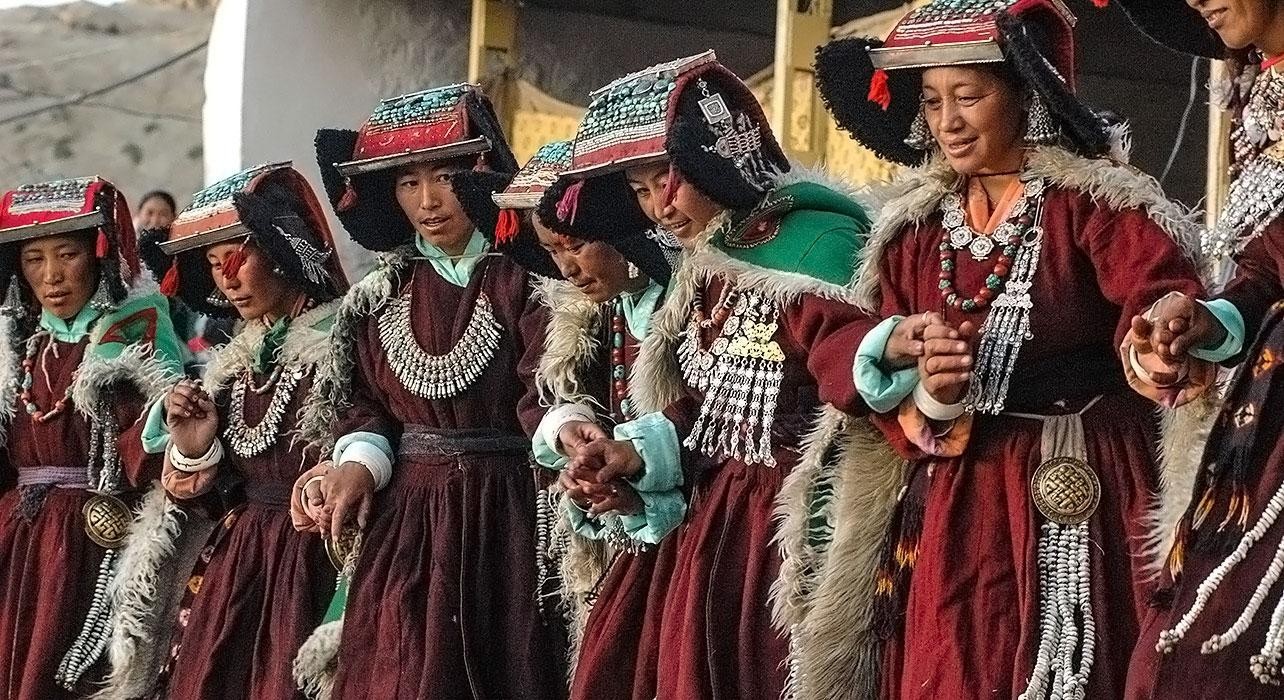
Photo: Pinterest
High on the Tibetan Plateau, where the Himalayas rise like silent witnesses to centuries of devotion, marriage is not merely a union between two individuals, it is a sacred crossing between families, destinies, and the unseen forces that shape life. Tibetan weddings unfold at the intersection of spirituality, ritual, and communal belonging, carrying echoes of ancient belief systems while quietly adapting to the rhythms of modern life. To witness a Tibetan wedding is to step into a world where symbolism governs movement, emotion is ritualized, and love, once dictated by obligation, is now increasingly chosen.
From Obligation to Affection: A Cultural Shift
For centuries, marriage in Tibet was primarily a familial responsibility rather than a personal choice. Parents arranged unions with great care, guided by lineage, compatibility, and social obligation. Obedience was expected, and children, especially daughters, were raised to accept these decisions without resistance. Many brides entered marriage having never seen their future husbands, leaving their childhood homes behind to join unfamiliar households, carrying little more than inherited duty and familial loyalty.
Yet Tibetan society, like all living cultures, evolves. In contemporary Tibet, love has slowly claimed its place alongside tradition. Today, most marriages are formed through personal connection and mutual affection. Men and women meet, fall in love, and decide to marry before informing their families, who remain deeply involved, but no longer authoritative decision-makers. This transition marks a profound cultural transformation: marriage has shifted from an inherited obligation to a shared choice, while still honoring ancestral values.
Weddings in Modern Tibet: Where Tradition Endures
Despite changing attitudes toward matchmaking, Tibetan wedding ceremonies remain deeply anchored in ritual. Proposals, engagements, and weddings continue to follow time-honored customs observed with reverence and precision. These ceremonies are marked by grandeur and solemnity, unfolding through a sequence of symbolic acts meant to bless, protect, and challenge the couple as they begin their shared life.
Modern influences gently weave themselves into these ancient structures. Horseback processions across vast landscapes, once essential, are now sometimes replaced or complemented by decorated vehicles. Practicality blends with pageantry, ensuring the ceremony remains both meaningful and adaptable. The result is a living tradition: neither frozen in the past nor detached from it.
Inside a Traditional Tibetan Wedding Ceremony
Preparations begin well before the wedding day. The groom’s family consults astrologers to select an auspicious date, aligning cosmic forces in favor of the union. On the eve of the ceremony, the bride receives a finely crafted wedding outfit and an elegant silk hairpiece, gifts that mark her transition into married life.
On the wedding day, a respected man from the groom’s family leads a vibrant procession. Arrows adorned with shimmering decorations symbolize protection and strength. A beautifully decorated horse, chosen according to the bride’s zodiac colors, carries the leader to the bride’s home. There, the bride’s family performs Qiema, a farewell ritual acknowledging separation, continuity, and emotional transition.
An arrow is pinned to the bride’s back, and a jade ornament is placed upon her head, symbolizing loyalty to her new household. Accompanied by her maid, she prepares to leave. Before departure, a family member chants a protective phrase while holding an arrow and a leg of mutton, warding off misfortune and blessing her path ahead. At the head of the procession rides an astrologer on a white horse, embodying guidance and cosmic favor. Songs fill the air, yet tears fall freely. The bride’s sorrow reflects the emotional complexity of departure, joy intertwined with grief, belonging reshaped rather than erased.
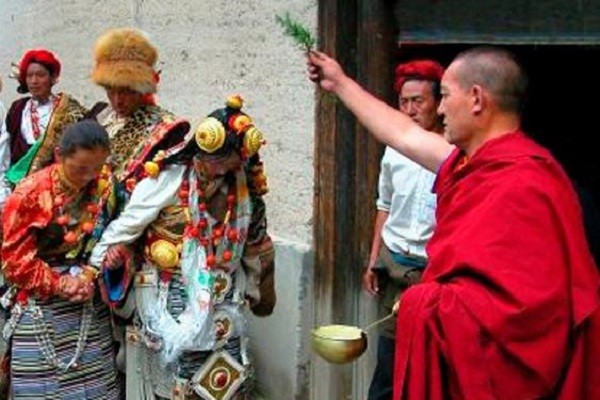
Along the journey, the groom’s family offers ceremonial toasts. Omens are closely watched; if illness or misfortune is encountered, monks intervene with chants to neutralize bad luck. Upon arrival, the groom’s home is adorned with barley cushions and offerings symbolizing prosperity. The bride walks upon barley and tea leaves before receiving the Khatag, a ceremonial silk scarf signifying respect and blessing.
The couple enters the home together, greeted by guests offering gifts and well-wishes. Later, lamas perform private blessings, sealing the spiritual dimension of the union. Outside, celebration erupts, singing, dancing, and feasting bind the community together.
In wealthy families, wedding celebrations can extend for weeks, though most last two to three days. Regardless of duration, Tibetan weddings remain profound expressions of identity, belief, and collective memory, where love, ritual, and community converge.
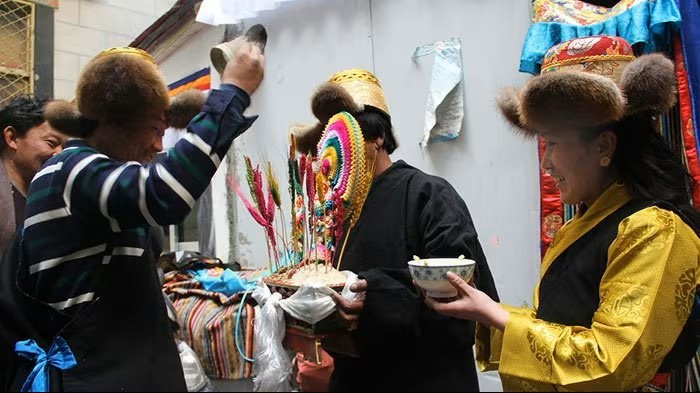
The host is treating guests with Qiema during Tibetan New Year
Photo: Pinterest
Dress, Ritual, and the Aesthetics of Restraint
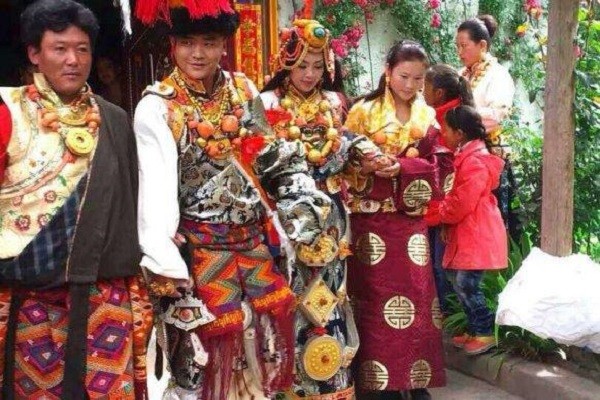
Dress itself functions as a ritual language. The chuba, traditionally worn by the bride and groom, is not a decorative costume but an ancestral inheritance. Its layered construction signifies protection, continuity, and belonging, marking not only the body, but one’s place within a social and cosmological order. Jewelry, most often turquoise and coral, is worn not as a display of wealth, but as a form of spiritual armor and social code, signaling family lineage and regional identity. These materials carry talismanic value, closely associated with protection, longevity, and well-being, a significance extensively documented in studies of Himalayan material culture, including the archives of the Rubin Museum.
The ceremony itself is deliberately collective. Elders guide the blessing rituals, monks may murmur prayers, and the traditional barley-based drink, chang, circulates not for pleasure, but as a ritual exchange among participants. There is no clear boundary between guest and participant; presence itself implies responsibility. Those in attendance are not witnessing a romantic spectacle, but bearing witness to continuity.
What defines the aesthetic of Tibetan weddings is a restraint deeply rooted in meaning. Nothing is excessive, because nothing is without purpose. Even the color palette, deep reds, earthen tones, mineral blues, mirrors the surrounding landscape, as if the environment itself were woven into the ceremony. Photography, when present, tends to adopt an observational rather than directive role, as the priority remains the ritual itself, not its documentation.
In Tibetan weddings, love is never loudly declared. It is assumed, maintained quietly through ritual, repetition, and shared belief. Elegance emerges not from visual drama, but from the harmony between body, belief, and environment.
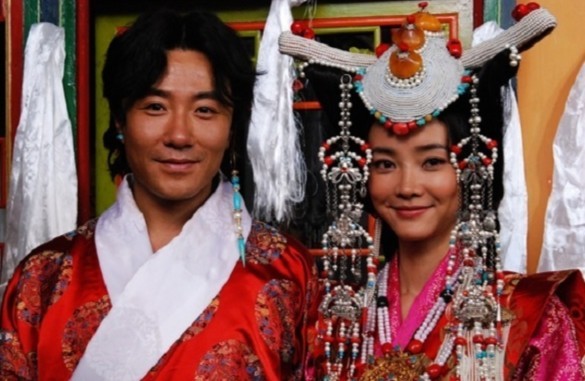
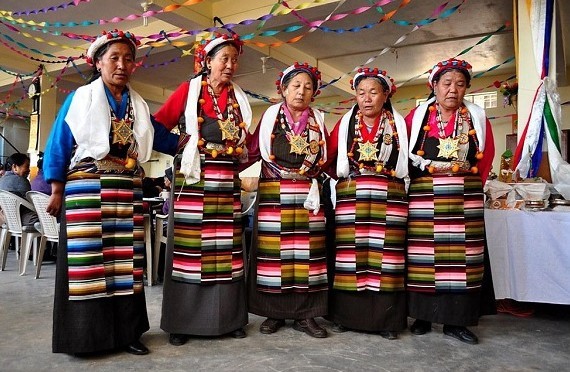
Photo: Pinterest
This article is an original editorial analysis produced by [DIBA magazine].
Research and references are used for contextual accuracy.