
|
EN
Subscribe to our Newsletter
In the heart of Shiraz, Hafezieh stands as a sanctuary of timeless verse, where cypress trees whisper secrets of love and roses echo the soul of Persian poetry. Each step through its fragrant gardens invites the visitor to wander between history, mysticism, and the eternal beauty of Hafez’s words.
By the Editorial Staff
Hafez of Shiraz, born Shams-al-Dīn Muḥammad Hāfez in the 14th century, stands among the most radiant voices of classical Persian poetry, a poet whose presence has never dimmed with time. His Divān, a treasury of ghazals shaped by rhythm, paradox, and luminous metaphor, continues to enchant hearts centuries after it was first gathered. Writing in an era marked by political turbulence and spiritual searching, Hafez transformed the Persian ghazal into a vessel of layered meaning at once earthly and celestial, intimate and universal. His verses move effortlessly between tavern and temple, between the longing of the lover and the yearning of the mystic, dissolving boundaries between the sensual and the sacred. Through the elegance of his language and the subtlety of his symbolism, he crafted poetry that invites endless interpretation, allowing each generation to rediscover itself within his lines.
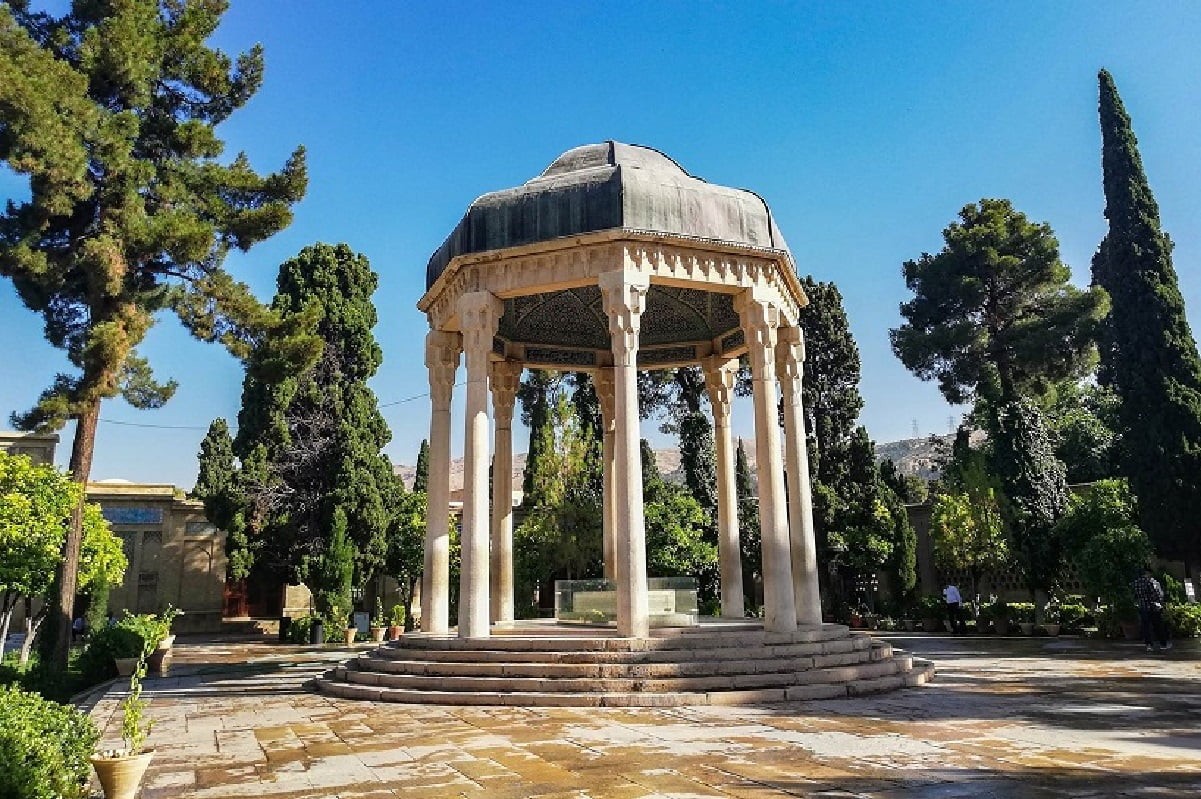
Hafezieh
Photo: Irun2iran
In each verse, Hafez weaves love, mysticism, irony, and the delicate nuances of human longing into melodies that linger like the fragrance of roses in Shiraz at dusk. His poetry captures life’s fleeting moments, a glance, a sigh, a cup of wine and transforms them into reflections of beauty, joy, and spiritual awakening. Blending lyrical grace with mystic imagery, he speaks of divine love through earthly metaphors, and of earthly sorrow with celestial hope. It is this shimmering ambiguity, this dance between revelation and concealment, that has drawn both Eastern and Western readers into his world. With his words, Hafez elevated the Persian ghazal into a timeless art form, a symphony of emotion and insight that transcends geography, language, and centuries, continuing to whisper its secrets to those who pause to listen.
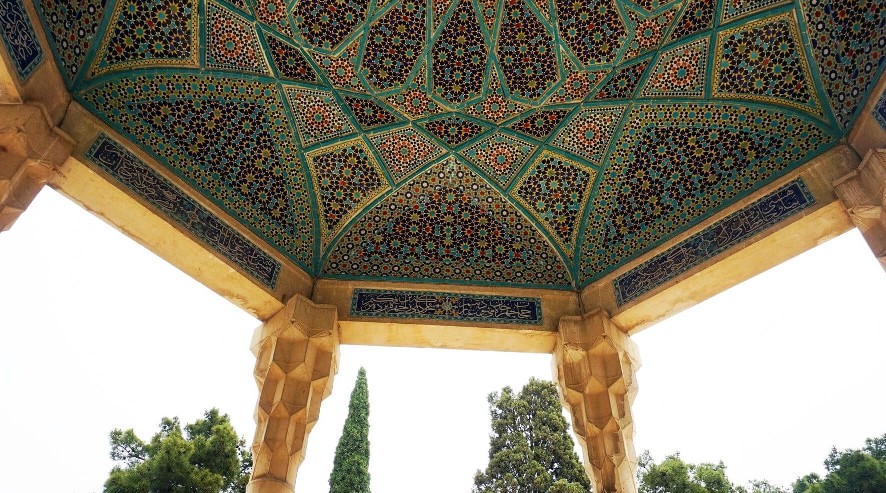
Hafezieh Shiraz
O happy Shiraz, and its peerless site O Lord it from decline, preserve
For our Roknabad, a hundred praises Whose limpid water life to Khizr gave
Between Jafar’Abad and Musalla Ambergis mixing, cometh its cool north
To Shiraz come, and bounty of the holy spirit Jibra’il For it from the man endowed with perfection Hafiz ask
Here in Shiraz who mentioneth Egyptian candy For the sweet ones the lovely ones
,the beloved ones ,the utterers of sweet words, of Shiraz have not given imputed to its hame
O breeze of that lovely ,wholly in toxicated wanton News, what hast thou Her state is what
For God's sake,from this dream ,awake me not For ,in its image,a sweet pleasure I have
If that sweet one spill my blood O heart it, like mother's milk, lawful hold
Hafiz when of separation, thou art affrighted ,why Offeredest not thou thanks for the time of union with the beloved
Hafezieh stands as one of the most refined examples of commemorative architecture in Iran not merely as a tomb complex, but as an evolving architectural narrative shaped across centuries. The monument is defined as much by spatial philosophy as by structure. It is organized as a ceremonial garden-ensemble in which architecture, geometry, water, inscription, and vegetation function as a unified symbolic system.
The complex today represents the culmination of layered construction phases that began in the 15th century and matured into the present architectural form in the 20th century, reflecting careful preservation, reinterpretation, and aesthetic continuity rather than abrupt reinvention.
The earliest recorded memorial structure at the site dates to 1451–1452 CE, when a modest domed pavilion was constructed over the grave within a cultivated garden space irrigated by the nearby Rokn-Abad stream. This initial architectural gesture established two enduring principles that still define the site: the integration of built form with landscape, and the use of a pavilion rather than a closed mausoleum chamber.
Unlike many enclosed funerary structures of the Islamic world, the early design emphasized permeability, open air, filtered light, and visual continuity with garden elements. This openness positioned the structure within the Persian tradition of commemorative garden pavilions rather than monumental tomb towers.
Over subsequent centuries, the complex experienced phases of restoration and embellishment. During the Safavid period, attention was given to maintaining the sanctity and structural integrity of the memorial. However, it was under the Zand dynasty in the 18th century, particularly during the reign of Karim Khan Zand, that the site underwent a transformative architectural expansion.
A more defined pavilion structure was erected, characterized by slender stone columns, a marble sarcophagus, and a more formally articulated garden setting. This intervention established a clearer axial organization and enhanced the ceremonial quality of the space. The Zand-era pavilion reflected architectural restraint, symmetry, proportional clarity, and emphasis on material refinement rather than excessive ornamentation.
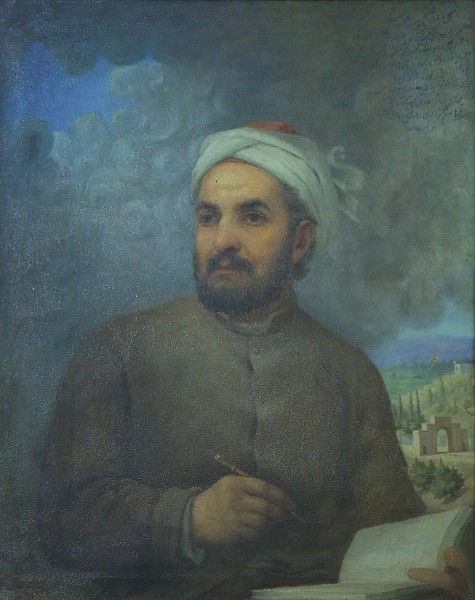
Photo: Pinterest
The marble tombstone introduced during this period remains one of the most significant physical elements of the complex. Carved from a single slab of stone, it features carefully inscribed calligraphy in the elegant Nastaliq script, a style traditionally associated with literary manuscripts. The inscriptional program elevates the tombstone from funerary marker to architectural manuscript. The stone rests upon a slightly raised platform, signaling both reverence and visibility within the spatial composition.
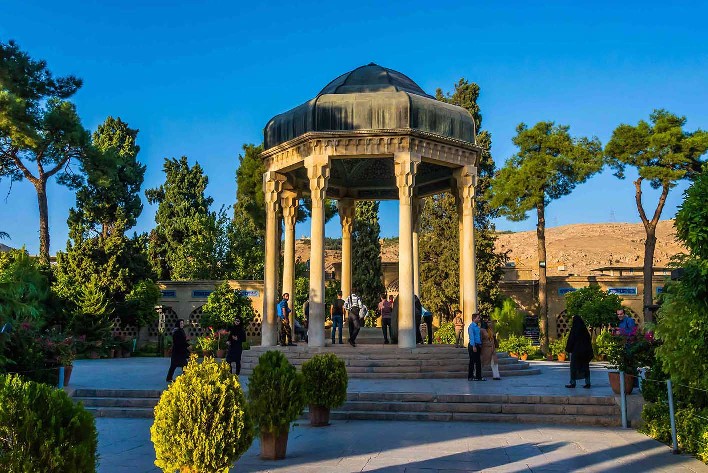
Photo: Pinterest
The most consequential architectural phase occurred between 1935 and 1938 CE, when the complex was redesigned under the supervision of André Godard, a French archaeologist and architect who played a significant role in Iranian heritage conservation during the early 20th century. Rather than reconstructing the site as a purely historical replica, Godard developed a synthesis of traditional Persian architectural vocabulary with modern structural sensibilities. His approach emphasized clarity of form, symbolic geometry, and visual lightness.
At the center of the present-day complex stands the octagonal pavilion, crowned with a copper-clad dome. The dome rests upon eight slender stone columns, each precisely spaced to create rhythmic openness. The octagonal plan is deeply rooted in Islamic architectural symbolism, frequently associated with transition between earth and sky, material and spiritual, square and circle. The eight columns are often interpreted as symbolic references to cosmological concepts, including the “eight gates of paradise” in Islamic tradition. Architecturally, however, they also perform a structural function: distributing the weight of the dome while preserving openness in all directions.
The dome itself is distinguished by its ribbed structure and interior tilework, decorated with geometric and arabesque motifs rendered in soft blues, turquoise, and warm earth tones. The interior surface features carefully arranged calligraphic panels, inscribed with verses in fluid Nastaliq script. The visual experience under the dome is one of upward movement: concentric ornamentation guides the eye toward the apex, reinforcing vertical transcendence through purely architectural means.
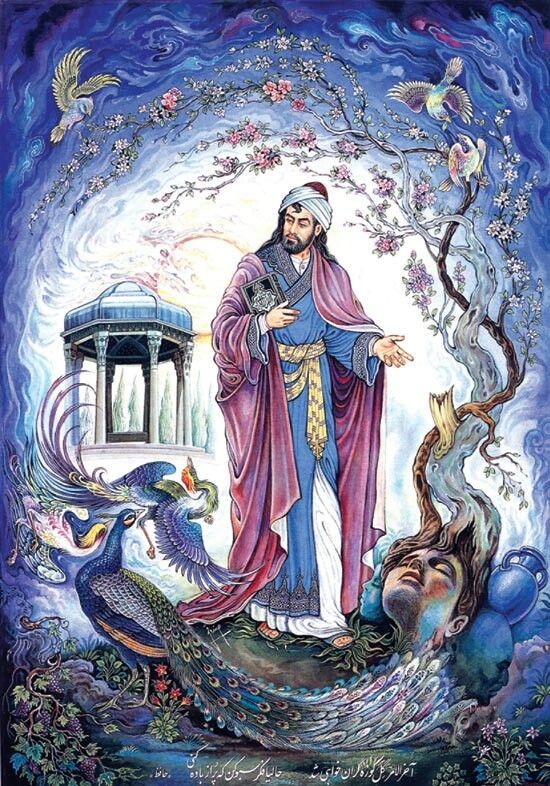
Unlike many mausoleums that enclose the burial chamber within heavy walls, Hafezieh’s pavilion remains open on all sides. This architectural permeability allows the tomb to remain in constant dialogue with light, wind, and seasonal change. Morning light enters from the east, casting elongated column shadows across the marble platform; at dusk, warm tones from the west soften the stone surfaces. The absence of enclosing walls ensures that architecture does not isolate the grave but frames it within a living environment.
Surrounding the central pavilion is a formally organized Persian garden, structured according to principles associated with the classical Chahar-bagh layout. While not a strict quadrilateral garden divided by water channels in the exact Safavid manner, the spatial organization maintains axial symmetry, water alignment, and controlled vegetation placement. The pathways are carefully aligned to draw visitors gradually toward the pavilion, reinforcing a sense of ceremonial progression.
Water plays a defining role in spatial composition. Reflecting pools mirror the dome and columns, doubling the vertical structure in liquid form. This reflection reinforces the architectural metaphor of duality earth and sky, form and image, permanence and ephemerality. The soft sound of water contributes an acoustic layer to the experience, tempering the silence without overwhelming it.
Vegetation within the complex includes cypress trees, traditionally associated with eternity and uprightness in Persian symbolic language, alongside seasonal flowers and orange trees that introduce fragrance and color. The landscaping avoids dense clustering; instead, trees are placed with measured spacing, allowing sightlines toward the pavilion from multiple vantage points. This openness maintains visual hierarchy: architecture remains focal, landscape supportive.
Beyond the main pavilion, additional structures within the complex include entrance gates, arcaded walkways, and surrounding porticos that frame the courtyard. These secondary elements create transitional zones between exterior approach and interior sanctuary. The use of stone in columns and platforms contrasts with brickwork and plaster detailing in peripheral buildings, demonstrating material hierarchy within the complex.
From a structural perspective, the pavilion represents a refined example of load distribution through columnar support rather than thick masonry walls. The slenderness of the columns contributes to aesthetic lightness while maintaining stability. The copper dome covering protects the underlying structure from weathering, and its patina has evolved over time, lending the monument a soft aged sheen rather than harsh metallic brightness.
Photo: Pinterest
Calligraphy remains integral to the architectural identity of Hafezieh. Inscriptions are not confined to the tombstone; selected verses appear within decorative frames under the dome and along surrounding surfaces. The interplay between written word and structural form transforms the site into a three-dimensional textual environment. Rather than treating text as ornament alone, the inscriptions serve as spatial anchors that guide attention and contemplation.
In terms of conservation history, the 20th-century reconstruction under Godard was part of a broader cultural preservation initiative in Iran aimed at restoring historically significant monuments with sensitivity to original character.
The intervention avoided excessive modernization; instead, it clarified geometry and stabilized the structure while maintaining continuity with earlier Zand-period elements. Subsequent conservation efforts have focused on maintaining stone integrity, tile restoration, and landscape management to preserve both architectural and environmental balance.
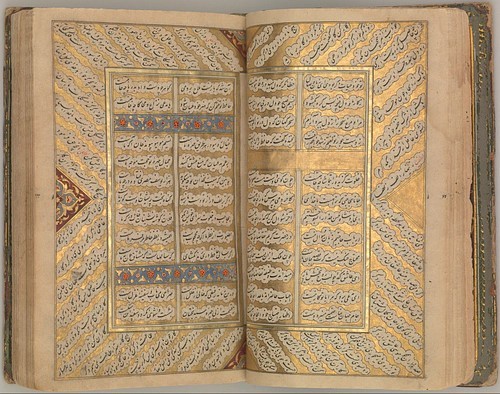
Anthology of Persian Poetry with the poems of Hafez Shiraz Folios 33r-32v Iran, 17th century CE
Photo: Metropolitan Museum of Art
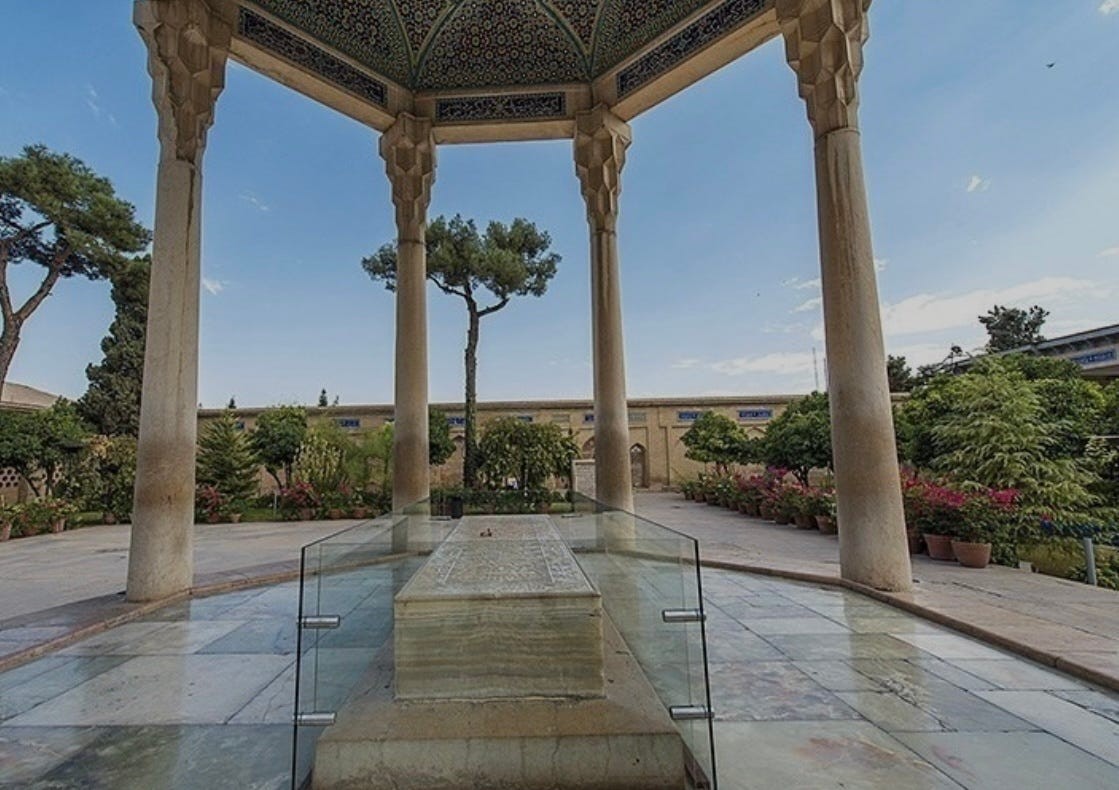
The architectural language of Hafezieh can be understood as a dialogue between monumentality and intimacy. While the dome and columns create a recognizable landmark silhouette, the scale remains human. Visitors stand close to the tombstone; the columns do not dwarf the individual. This proportional calibration fosters contemplative proximity rather than distant admiration.
The complex also demonstrates mastery of axis and procession. Entry pathways are deliberately sequenced so that the central pavilion is gradually revealed rather than immediately confronted. This choreographed unveiling heightens spatial drama while maintaining serenity. The central axis aligns water, walkway, and pavilion in geometric coherence, reinforcing classical Persian design principles.
Material selection further enhances the architectural identity. Marble conveys permanence and luminosity; stone columns provide structural clarity; glazed tiles introduce chromatic refinement; copper adds durability and subtle brilliance. The restrained color palette cream stone, turquoise tile, green foliage, reflective water sustains visual harmony without overwhelming ornament.
Photo: Shadi Jahazi
At night, controlled illumination highlights the columns and dome, transforming the pavilion into a floating form within the garden darkness. Light sources are positioned to emphasize vertical lines and dome curvature rather than flood the entire complex, preserving atmospheric depth. The reflected glow on water surfaces amplifies spatial dimension, creating layered luminosity.
Acoustically, the open pavilion allows ambient sounds, footsteps on stone, breeze through trees, distant water to circulate naturally. The absence of enclosed echo chambers maintains auditory softness. Architecture does not isolate; it frames sensory experience.
In scholarly discussions of Iranian commemorative architecture, Hafezieh is frequently cited as an example of modern reinterpretation of traditional forms. It does not replicate medieval mausoleum towers nor Safavid domed chambers exactly; instead, it abstracts and refines these precedents into a balanced composition suited to contemporary structural techniques of the 20th century.
The octagon, dome, and column arrangement together create a geometry of equilibrium. The square platform transitions to the octagonal drum, which transitions to the circular dome, a symbolic architectural ascent from earthly stability to celestial unity. This geometric progression is subtle yet deliberate, embodying architectural metaphysics through structural transformation.
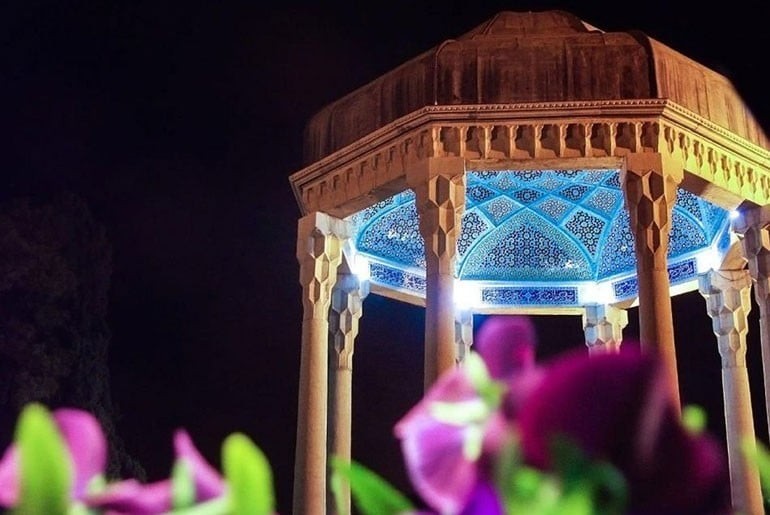
Photo: Surfiran.com
Landscape maintenance within the complex continues to follow principles of measured symmetry and seasonal renewal. Flower beds are rotated periodically to sustain color diversity, while cypress alignments preserve axial clarity. Water channels are regularly restored to ensure reflective integrity.
Ultimately, Hafezieh endures as more than a preserved historical monument. It is a carefully orchestrated architectural environment in which structure, geometry, inscription, and garden composition converge into a unified spatial philosophy. Each column, tile, pool, and pathway contributes to an intentional design language centered on openness, balance, and contemplative harmony. The monument’s evolution from 15th-century garden pavilion to Zand-era sanctuary to Godard’s 20th-century architectural synthesis reflects continuity rather than rupture.
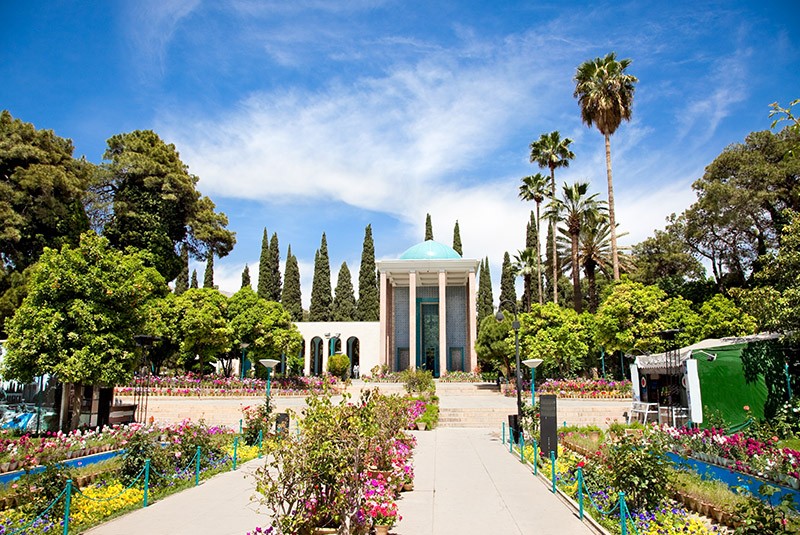
Hafezieh endures not simply as a tomb, but as a carefully composed architectural statement shaped across centuries.
From its early garden pavilion to the Zand-era refinements and the 20th-century reconstruction, each phase strengthened its spatial coherence rather than altering its essence.
The octagonal dome, slender columns, marble platforms, inscriptions, and surrounding garden elements work together in measured balance, creating a unified composition of stone, light, and geometry.
What gives the monument its lasting power is this harmony between structure and symbolism. Architecture, landscape, and proportion converge to form a space designed for contemplation.
Through continuity, restraint, and symbolic clarity, Hafezieh stands as a refined example of how built form can preserve meaning while evolving through time.
Eram Garden, shiraz
Photo: eavartravel.com
This article is an original editorial analysis produced by [DIBA magazine]
Research and references are used for contextual accuracy.