
|
EN
Subscribe to our Newsletter
The introduction of radio and television to Iran was never a neutral technological shift. These objects entered domestic life carrying systems of order, reshaping space, disciplining bodies, and reorganizing everyday perception. What we now identify as Iranian vintage radio and television are not nostalgic artifacts, but material witnesses to a compressed encounter with modernity, where image, authority, and domestic life became inseparably intertwined.
By the Editorial Staff
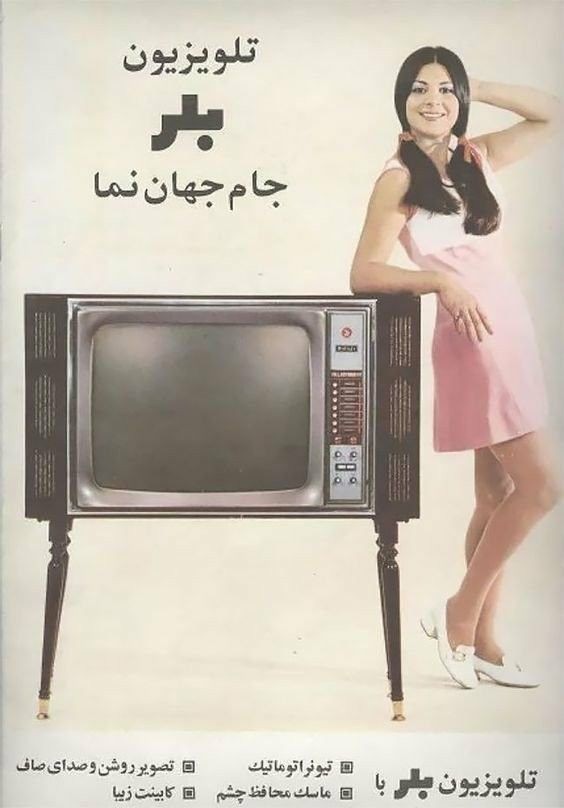
Photo by: Pinterest
Radio and Television as Vintage Objects in Iran
Technology, Power, and the Regulation of the Body in Compressed Modernity
The arrival of radio and television in Iran cannot be understood merely as the introduction of new technological devices. These objects carried far more than sound and image; they carried a system of order, one that reshaped space, disciplined bodies, structured time, and reconfigured everyday life. What is now recognized as “Iranian vintage radio and television” represents the material residue of a particular encounter with modernity: an encounter that was not gradual, but accelerated, state-driven, and deeply ideological.
In much of Europe and North America, mass media developed alongside long processes of industrialization, urbanization, and consumer culture. Radio and television entered domestic life incrementally, embedded within an already-evolving social structure. In Iran, particularly during the 1960s and 1970s, this trajectory was compressed. Media technologies arrived before society had fully negotiated their cultural implications. As a result, radio and television functioned as instruments of temporal acceleration, technologies that attempted to bridge the gap between tradition and modernity not through dialogue, but through image.
Television, in particular, assumed a role far beyond entertainment. In many Iranian households, it became the symbolic and spatial center of the home. Furniture arrangements, bodily orientations, and collective attention were organized around the screen. The living room, especially within the urban middle class, was transformed into a site of shared viewing, where multiple bodies aligned their gaze toward a single source of authority. Television did not simply occupy space; it structured it.
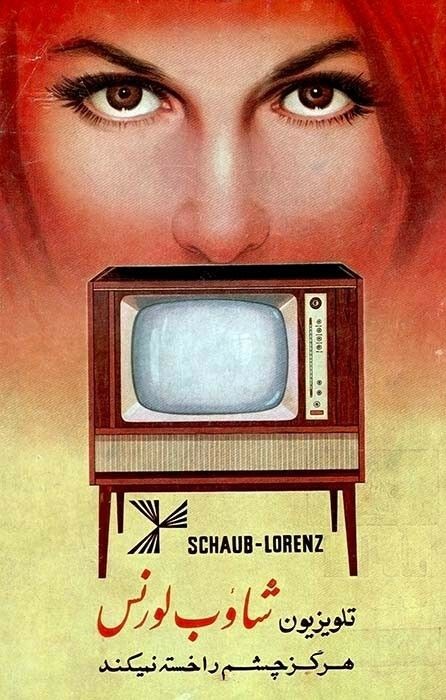
Photo by: Pinterest
This structuring was never neutral. Pre-revolutionary Iranian television played an active role in producing and stabilizing images of the “desirable life.” Bodies, gender roles, family relations, and aesthetic ideals were repeatedly staged and normalized through broadcast imagery. The modern woman, the working man, the orderly nuclear family, these were not passive representations but prescriptive models.
Through repetition, television trained the eye. It taught viewers not only what to see, but how to see.
The physical design of radios and televisions commonly used in Iran further reinforced this logic. Many sets, whether imported or locally assembled, were housed in heavy, wooden, furniture-like casings. They were designed to resemble domestic objects rather than machines. This formal choice was not incidental. For technology to be accepted, it had to appear “habitable.” Modernity needed to be softened, domesticated, and made visually compatible with the logic of the Iranian home.
Watching television in that era also produced a specific bodily condition. Bodies became still, postures stabilized, gazes fixed, and sound acquired authority. Television was not background noise; it was an event. This embodied mode of viewing, this particular choreography of sitting, watching, and listening, is inseparable from the historical meaning of these objects. It is precisely this bodily regulation that renders them vintage today.
The vintage status of Iranian radios and televisions is therefore not a matter of age alone. These objects belong to a mode of modernity that no longer dominates, a modernity that sought to educate, discipline, and unify through image, and to regulate the body through objects. They function as material and visual documents of a historical moment in which technology, power, and everyday life were tightly interwoven.
To look at Iranian vintage radio and television is not to indulge in nostalgia, nor to romanticize the past. It is an act of critical reading. Such objects allow us to examine how technologies exceed their functional roles and become tools for understanding broader relationships between media, authority, embodiment, and vision.
Radio and television in Iran were never merely media devices. They organized domestic space, disciplined the body, and trained the gaze. This is why, as vintage objects, they remain active—not as sentimental artifacts, but as instruments of thought.
This article is an original editorial analysis produced by [DIBA magazine].
Research and references are used for contextual accuracy.