
|
EN
Subscribe to our Newsletter
Long before furniture became optimized, minimal, and endlessly ergonomic, chairs were sites of ideological tension. In the 1970s, seating design underwent a radical shift, one that questioned discipline, posture, and the authority of form itself. The chairs now labeled as “vintage” did not emerge as nostalgic objects, but as responses to a cultural moment that sought softness over control and experience over precision. To sit, in this decade, was no longer to obey form, but to negotiate it.
By the Editorial Staff

Photo by: Getty Image
The Chair as a Vintage Object
Body, Ideology, and Form in 1970s Design
The chair occupies a unique position within the history of design. More than most designed objects, it maintains an intimate, unavoidable relationship with the human body. To design a chair is to propose a theory of how the body should exist in space, how it should rest, how it should behave, how it should be disciplined or liberated. Every chair, whether consciously or not, encodes an ideology of posture, comfort, and control.
The 1970s marked a decisive rupture in this relationship. During this decade, the chair ceased to function merely as a rational solution to a functional problem. Instead, it became a site of experimentation, resistance, and cultural critique. Many of the chairs now classified as “vintage” emerged directly from this historical moment, not as timeless objects, but as deeply situated responses to a crisis in modernism, industrial logic, and fixed social order.
To understand why 1970s chairs continue to resonate today, we must move beyond nostalgia and style. These objects must be read as cultural documents, material records of a moment when design questioned its own authority.
Modernism and the Disciplined Body
To grasp the radical nature of 1970s seating design, it is necessary to understand what came before it. Modernist chairs of the early to mid-20th century, particularly those associated with Bauhaus, functionalism, and international modernism, were grounded in principles of rationality, efficiency, and standardization. The body, in this framework, was treated as a unit to be optimized.
Designers such as Marcel Breuer, Mies van der Rohe, and Le Corbusier conceived chairs as architectural extensions: skeletal structures, exposed frames, and precise angles that instructed the body how to sit “correctly.” Ergonomics functioned less as a tool of comfort and more as a mechanism of discipline. The modernist chair did not adapt to the body; the body adapted to the chair.
This logic mirrored broader social structures. Modernism aligned itself with industrial production, bureaucratic order, and the belief that rational design could produce a better, more efficient society. Seating became a form of behavioral regulation, upright, alert, productive. By the late 1960s, this model began to fracture.
Crisis, Counterculture, and the Rejection of Order
The late 1960s and early 1970s were marked by widespread political, social, and cultural upheaval. Anti-war movements, feminist theory, civil rights struggles, and critiques of industrial capitalism reshaped how individuals understood authority, labor, and the body itself. Design did not exist outside these transformations. On the contrary, it absorbed them.
The modernist promise, that rational form could produce social harmony, began to feel hollow. Standardization increasingly appeared as alienation. The disciplined body came to be associated with institutional control: offices, schools, factories, and state power.
Against this backdrop, designers began to question the very premise of “correct” posture.
Why should the body sit upright? Why should comfort be measured by productivity?
Why should furniture enforce order rather than accommodate desire, fatigue, pleasure, or withdrawal?
The chair became an ideal site for this critique.
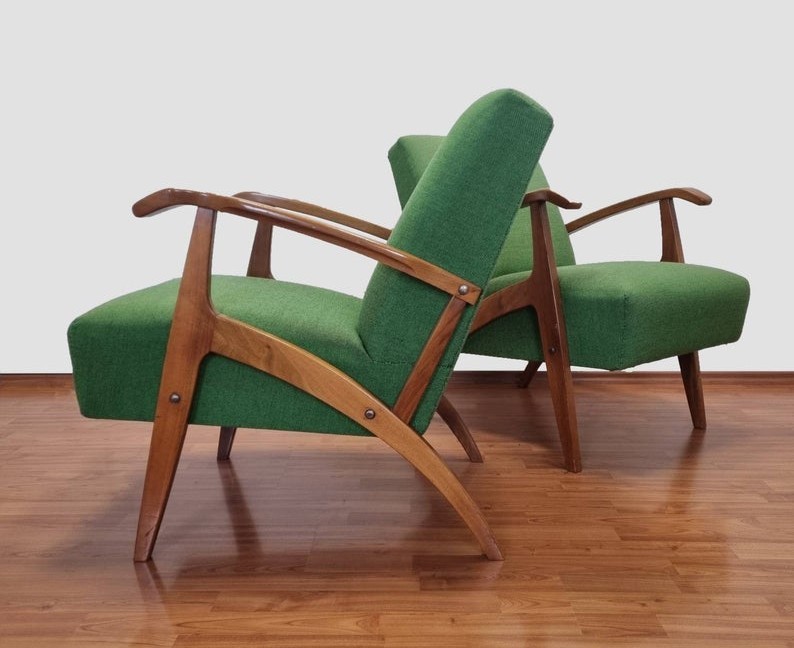
Photo by: Getty Image
When Form Became Soft
One of the most striking shifts in 1970s chair design is formal. Chairs became soft, low, voluminous, and enveloping. Rigid frames gave way to foam, fabric, and molded plastics. Angles dissolved into curves. Legs disappeared. Structure became implicit rather than visible. This softness was not decorative. It was ideological.
Expanded polyurethane foam allowed designers to abandon internal skeletons altogether. Chairs could now be shaped around bodily pressure rather than mechanical support. Seating became less about posture and more about sensation.
In many cases, these chairs appear deliberately “non-ergonomic” by conventional standards. They slump. They tilt. They collapse under weight. And yet, this apparent dysfunction was precisely the point. The chair no longer corrected the body; it surrendered to it.
This marked a profound reversal in design logic.
The Sacco Chair: The End of Structure
Few objects embody this reversal as completely as the Sacco Chair, designed by Piero Gatti, Cesare Paolini, and Franco Teodoro in 1968 for Zanotta.
The Sacco eliminated structure entirely. No legs. No frame. No fixed orientation. Filled with polystyrene beads, it responded dynamically to the body’s weight, forcing the sitter to negotiate form in real time.
Here, the act of sitting is no longer predetermined. The chair does not instruct the body; it follows it.
The Sacco destabilized the authority of design itself. It refused to define what a chair should look like or how it should be used. In doing so, it challenged the hierarchical relationship between designer, object, and user.
This was not comfort as convenience. It was comfort as freedom, and as uncertainty.
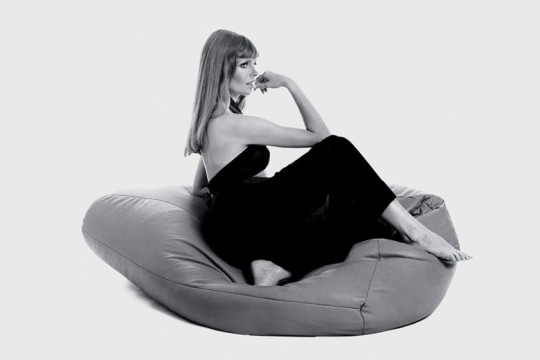
Sacco, Zanotta, Anatomical armchair, 1969.
Photo by: Getty Image
Togo and the Politics of Reclining
Michel Ducaroy’s Togo Chair (1973) represents a different but equally radical approach. Unlike the Sacco, the Togo retains a recognizable form. Yet it rejects the upright posture traditionally associated with seating.
Low to the ground, deeply padded, and pleated like an accordion, the Togo invites reclining rather than sitting. It absorbs the body’s weight and encourages sprawl, rest, and duration. The Togo was not designed for tables, desks, or productivity. It was designed for inhabitation.
This shift has political implications. To recline is to refuse readiness. To sink is to reject alertness. In a culture increasingly defined by speed and output, the Togo proposed an alternative temporality, one grounded in rest, presence, and bodily awareness.
Feminism, Domestic Space, and the Body
The transformation of chair design in the 1970s cannot be separated from feminist critiques of domesticity and labor. Traditional furniture often encoded gendered expectations: upright chairs for work and authority, soft seating for passivity and leisure.
Many 1970s chairs complicated these distinctions. They blurred boundaries between public and private, work and rest, masculinity and femininity. Soft, enveloping forms rejected the visual language of power historically associated with masculinity—rigidity, sharpness, exposure. Instead, they embraced tactility, intimacy, and vulnerability.
In this context, softness itself became political.
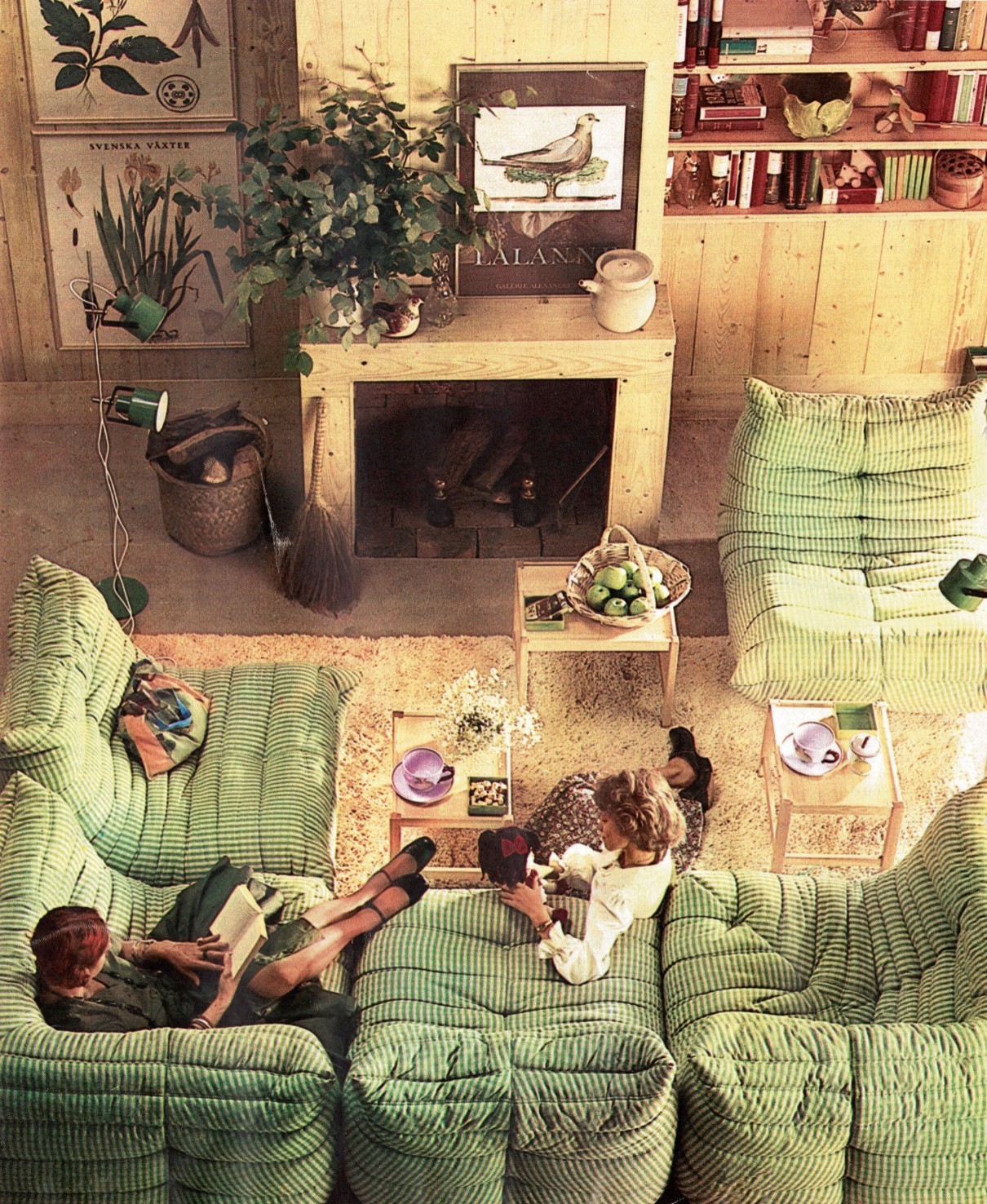
Photo by: Pinterest
Vintage as a Concept, Not a Style
Today, chairs from this era are frequently labeled as “vintage.” Yet this designation risks flattening their meaning. Vintage, in this case, does not simply refer to age or rarity. It signals a different design logic, one that no longer dominates.
These objects originate from a moment when design was allowed to be speculative, excessive, and unresolved. They predate the full integration of design into accelerated consumer cycles, branding strategies, and algorithmic optimization.
To call them vintage is not to romanticize the past. It is to acknowledge that they belong to an alternative epistemology of design, one centered on the body rather than the market.
Why the 1970s Chair Has Returned
The contemporary revival of 1970s seating across interiors, fashion imagery, and visual culture is not accidental. It reflects a growing dissatisfaction with contemporary design’s obsession with minimalism, efficiency, and dematerialization.
Today’s design culture often prioritizes lightness, flexibility, and visual neutrality. Bodies are expected to adapt to mobile lifestyles, remote work, and constant connectivity. Against this backdrop, the weight and volume of 1970s chairs feel subversive. They resist portability. They demand space. They insist on duration.
They remind us that design can be slow. That it can privilege presence over optimization. That it can remain unresolved.
The Chair as Cultural Archive
Ultimately, vintage chairs of the 1970s endure not because they are fashionable, but because they continue to ask questions.
What does it mean to rest?
Who controls the body in space?
Can design accommodate vulnerability without correcting it?
Can objects resist speed, productivity, and clarity?
These chairs do not offer answers. They offer conditions for thinking.
Perhaps this is why they continue to feel alive, not as nostalgic artifacts, but as reminders that design, like the body itself, can always be otherwise.
This article is an original editorial analysis produced by [DIBA magazine].
Research and references are used for contextual accuracy.