
|
EN
Subscribe to our Newsletter
In the workshops of Shiraz, felt is not woven but slowly coaxed into being, shaped by moisture, pressure, and human touch. Made entirely from wool and natural elements, this ancient craft carries the memory of hands, time, and landscape in every fiber.
By the Editorial Staff
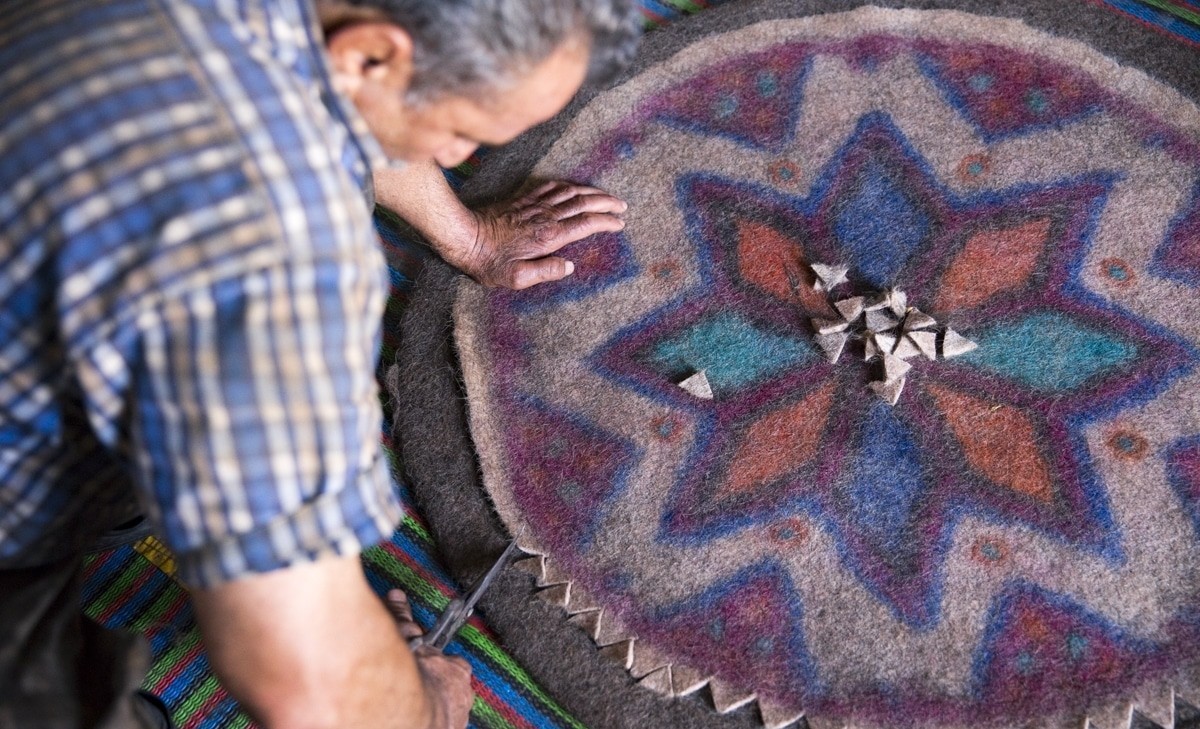
Photo: Reza Ghaderi
Felt: The Quiet Architecture of Wool and Tradition in Shiraz
Felt is among the oldest textile forms known to humankind, an elemental fabric shaped not by loom or shuttle, but by pressure, heat, moisture, and time. In Iran, and particularly in Shiraz, felt-making is not merely a craft but a ritualized dialogue between nature and human touch, one that has endured for centuries with remarkable continuity.
Unlike woven textiles, felt is formed without weaving. Instead, long-staple spring wool, prized for its elasticity and strength, is coaxed into cohesion through repeated compression and humidity. As the fibers swell and interlock, they create a dense, resilient surface that is at once raw and refined. Traditional artisans often enhance the process using natural agents such as soap or egg yolk, substances that soften the fibers and encourage deeper entanglement, lending the final piece both durability and subtle sheen.
Shiraz has long been one of Iran’s quiet centers of felt production, alongside other historic cities where the craft has survived through oral transmission and apprenticeship rather than formal documentation. Felted textiles from Shiraz have adorned Iranian homes for generations, used as floor coverings, prayer mats, saddlebags, and ceremonial objects, valued not only for their functionality, but for their unmistakable warmth and tactility.
What distinguishes Shirazi felt-making is its deeply intuitive approach to design. Master craftsmen rarely rely on fixed patterns. Instead, motifs emerge organically, composed directly onto the wool base through improvisation. Colored wool is placed by hand, guided by memory, instinct, and inherited visual language. The resulting designs often feel spontaneous yet grounded, abstract florals, symbolic forms, or rhythmic geometries that echo the surrounding landscape.
Color, too, is drawn from nature. Plant-based dyes and mineral pigments are used to tint the wool, ensuring that the finished felt remains an extension of the natural world. The palette is typically earthy and restrained, ochres, indigos, deep reds, and softened neutrals, allowing texture to speak as loudly as color.
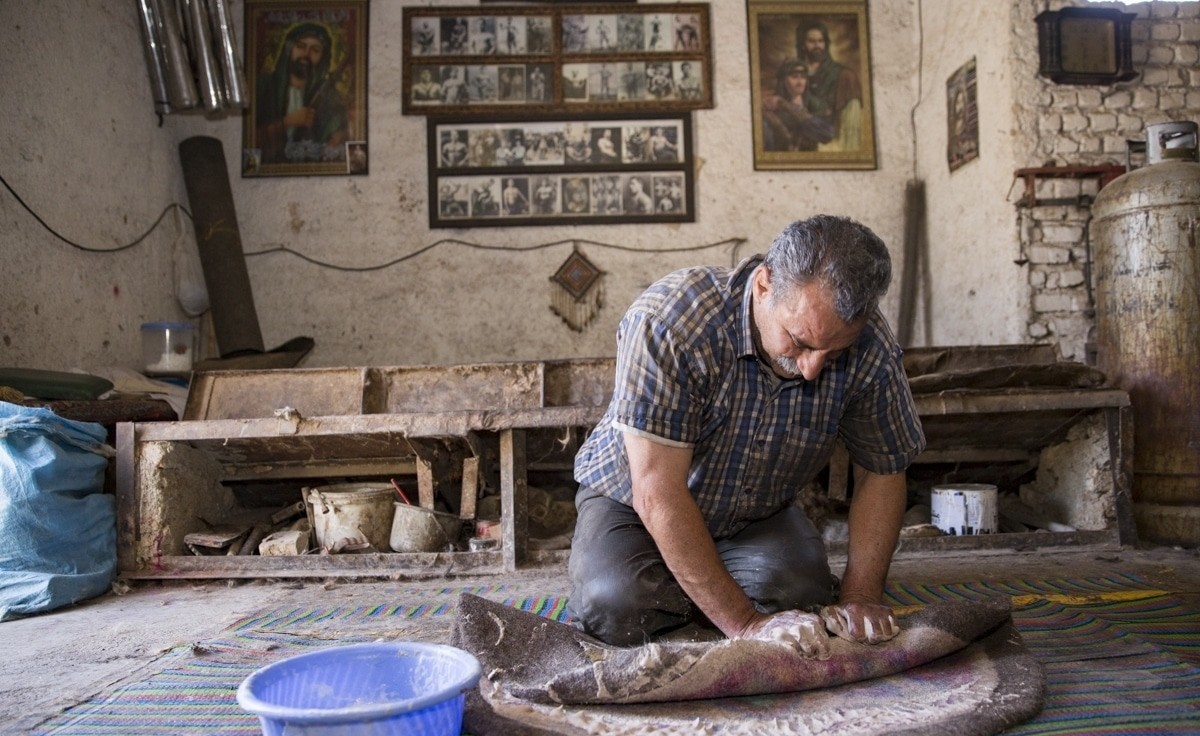
Photo: Reza Ghaderi
The Making of Felt in Shiraz: A Slow, Physical Process
The felting process unfolds across several demanding stages, each requiring physical endurance and practiced precision. In some workshops, freshly shorn sheep’s wool is first cleaned using a batting machine to remove dust and impurities. Traditional masters, however, still favor the use of a hand bow, a curved wooden tool strung with taut wire, which they strike rhythmically to fluff and purify the fibers. The sound itself is part of the workshop’s atmosphere: percussive, meditative, and deeply familiar.
Once prepared, the wool is laid out on the ground over a fabric or woven reed base. Guided by an internal design rather than a drawn template, the craftsman arranges colored wool directly onto the surface, building the composition layer by layer. Water is then sprinkled gently by hand, activating the fibers. Additional undyed wool is spread across the design to unify the surface, followed by another application of water.
The piece is then rolled, bound, and subjected to sustained beating, often for an hour or more. This physically demanding stage is essential, as it encourages the fibers to lock together permanently. Soap and warm water are introduced to further tighten the structure, transforming loose wool into a cohesive textile.
After drying, the felt is thoroughly rinsed and left to air dry. In some cases, artisans return to the surface to enhance certain areas with additional color, sharpening contrasts and refining motifs. The final result is a textile that feels both ancient and immediate, each piece unmistakably handmade, carrying the marks of its maker.
In an age dominated by speed, replication, and digital precision, felt from Shiraz stands as a counterpoint: slow, tactile, and resolutely human. It is a material shaped by hands, time, and instinct, an art form that continues to breathe quietly at the intersection of tradition, nature, and design.
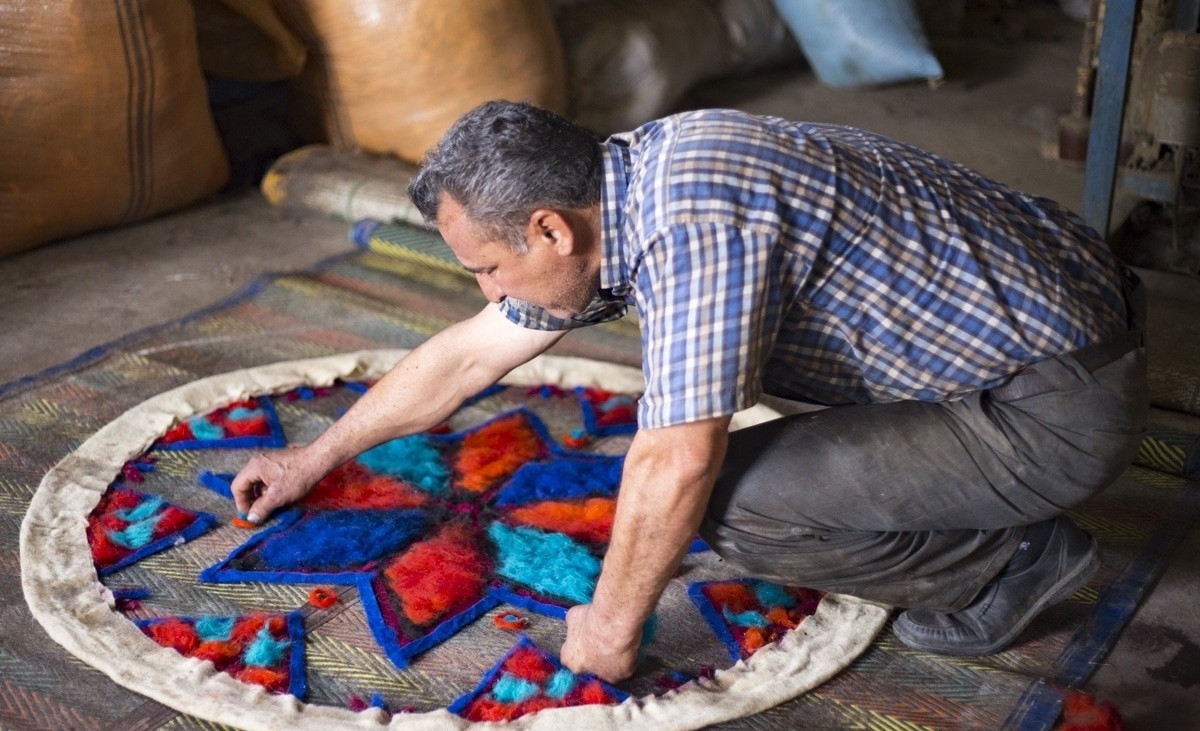
Photo: Reza Ghaderi
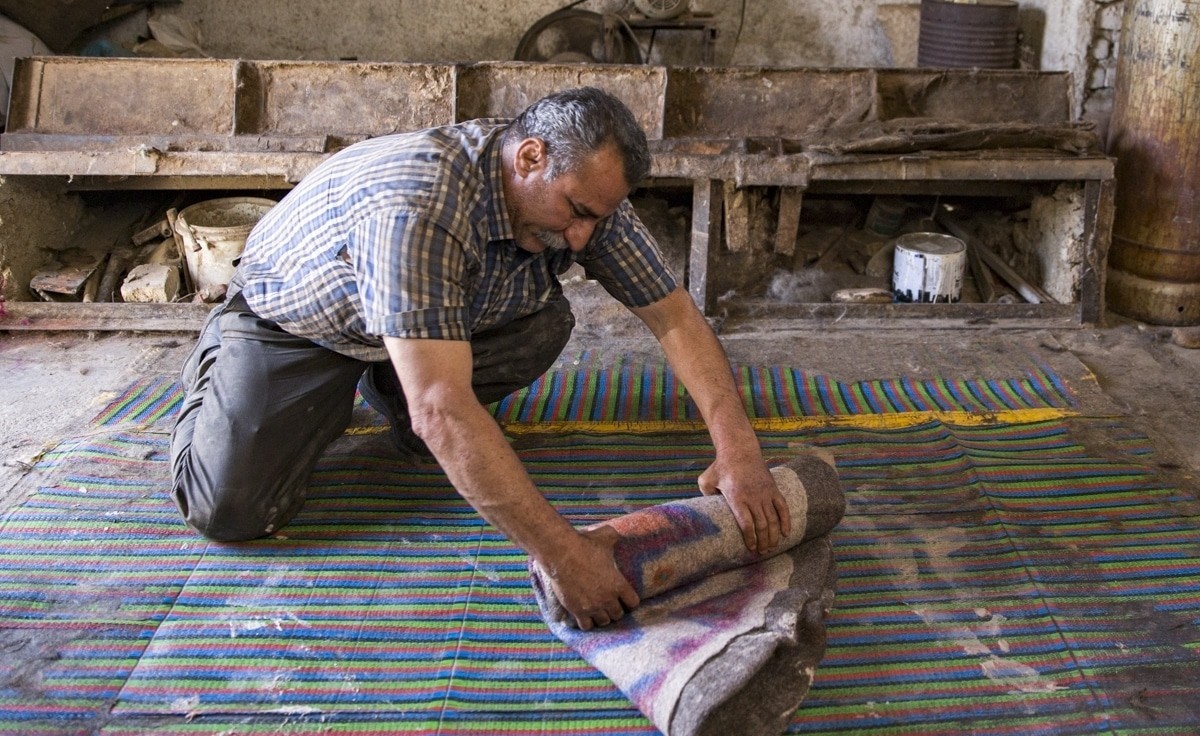
Photo: Reza Ghaderi
This article is an original editorial analysis produced by [DIBA magazine].
Research and references are used for contextual accuracy.