
|
EN
Subscribe to our Newsletter
Sevdaliza occupies a rare position at the intersection of art, sound, and fashion, where voice operates as a physical force rather than an auditory accessory. This article traces her biography, artistic philosophy, and presence within fashion culture to examine how sound becomes embodied, how garments function as resistance, and how fashion transforms into a site of political expression. In Sevdaliza’s world, clothing does not accompany sound; it speaks.
By the Editorial Staff

Photo: Wallpaper
Some artists enter the cultural landscape quietly. Others arrive as a rupture. Sevdaliza belongs firmly to the latter category, an artist whose work does not seek comfort, clarity, or easy recognition, but instead insists on friction, density, and presence.
Born Fatima-Yasmin Djamour in Tehran in 1987, Sevdaliza left Iran with her family at an early age and grew up in the Netherlands. This early displacement, between languages, geographies, and cultural codes, forms the silent architecture of her artistic voice. Migration, in her work, is not a subject to be explained; it is a condition. A state of being shaped by constant negotiation between visibility and fracture, belonging and distance.
Before music claimed her fully, Sevdaliza pursued professional basketball at an elite level. This chapter of her life is often treated as an anecdote, but its influence runs far deeper. Discipline, endurance, physical control, and resistance were not abstract concepts but daily realities. This embodied intelligence remains central to her artistic practice. In Sevdaliza’s universe, the body is never metaphorical, it is factual.
When she turned toward music in the early 2010s, sound was never approached as entertainment. Her voice does not perform emotion; it compresses it. Often restrained, sometimes hovering at the edge of rupture, her vocal delivery operates as a site of tension rather than release. The intimacy of her work does not arrive through confession or narrative clarity, but through weight. Listening feels physical. Sound presses. Sound resists.
Across early releases and breakthrough projects such as The Suspended Kid, Children of Silk, and her debut album ISON, Sevdaliza developed a language that blurred trip-hop, experimental pop, alternative R&B, and art music into something unmistakably her own. Genre, for her, is not a container but a material, bent, layered, and reconfigured. Each record feels less like a collection of songs and more like a sculptural environment.
This approach matured further with Shabrang, a work marked by restraint and gravity. Where earlier compositions leaned into sharp contrast and tension, Shabrang moves with slower pulses and controlled intensity. The shift is not toward softness, but toward density, music that settles into the body rather than exploding outward.
What makes Sevdaliza singular is not simply her sound, but how it extends beyond music. Her artistic practice moves seamlessly across visual language, performance, and fashion, without allowing any one discipline to become decorative. In her world, aesthetics are never neutral.
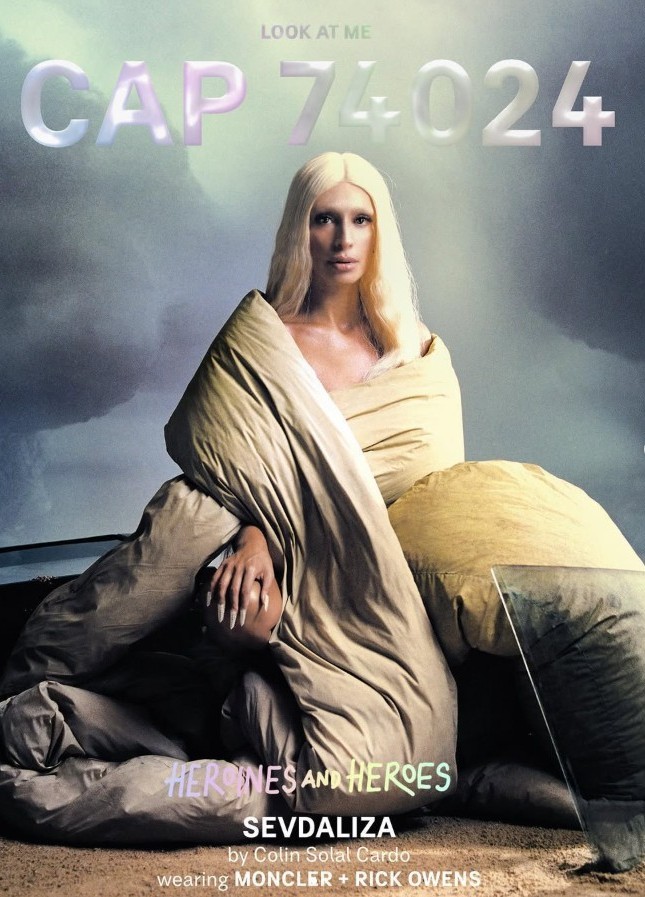
This is why her presence within contemporary fashion culture feels so precise. Sevdaliza does not function as a muse in the traditional sense, nor as an image to be styled. She operates as a medium. Collaborations with houses such as Balenciaga and Loewe do not dilute her stance; they sharpen it. Clothing, like sound, becomes an instrument.
Garments rarely relax the body. They compress, stretch, restrict, or armor it. Silhouettes resist fluidity. Fabrics hold tension. The body is not dressed for ease, it is articulated under pressure. Here, fashion mirrors voice. Cut becomes frequency. Compression echoes vocal strain. Form becomes position.
In this equivalence, garment as voice, voice as body, fashion exits the realm of consumption and enters the realm of statement. The clothes associated with Sevdaliza do not aim to flatter. They demand confrontation. They insist on being felt.
Her significance within the contemporary Art × Sound × Fashion landscape lies precisely here. Sevdaliza demonstrates that an artist can operate politically without slogans, personally without confession, and radically without spectacle. At a time when culture is increasingly flattened into images designed for rapid circulation, her work insists on embodiment, on friction that lingers, on sensation that cannot be scrolled past.
To encounter Sevdaliza is not to consume a product. It is to enter a state. One where sound is inseparable from flesh, where clothing carries weight, and where presence itself becomes an act of resistance.
In her world, nothing is ornamental. Everything presses back.
This article is an original editorial analysis produced by [DIBA magazine].
Research and references are used for contextual accuracy.
Photo: Wallpaper